Tuesday, February 18, 2025

A Supremacy of Nerds

 "So the shift is away from RGLB as a covering theme to "finish the coup." Instead ours can be a counter movement within the re-embrace of citizenship." 

There has long been a limitation, you could say resistance to defining citizenship as the basic building block of our nation.  John Adams argued that 

"The same reasoning which will induce you to admit all men who have no property, to vote, with those who have, . . . will prove that you ought to admit women and children; for, generally speaking, women and children have as good judgments, and as independent minds, as those men who are wholly destitute of property; these last being to all intents and purposes as much dependent upon others, who will please to feed, clothe, and employ them, as women are upon their husbands, or children on their parents.”

So there is a history here that not only implies a caste-like ranking of the population but has worked to understand "life, liberty and the pursuit of happiness" as preferably accomplished by those holding property.  Notice that Adams' argument does not leave all work to a "landed gentry" but clearly intends for those "destitute of property" to labor and earn their keep through employment, as dependent on the propertied as are "children on their parents." 

Certainly there were other currents working against a broad understanding of citizenship.  You'll not read any DEI adjacent arguments from those steamy late 18th century Philadelphia summers.  And finally Adams' argument as it came specifically to address voting was to "leave it to the states." I will not argue beyond indicating the long struggle between state and federal "forces" regarding the voting franchise than to say African-Americans were finally fully franchised by the federal government in my lifetime.  

My sad point is that our history has more years than not where the definition of citizen served other interests and suffered many prejudices and fears.  It's as if it was never really the first concern or default set in each era's arguments and contentions about our government.  I say this with some incredulity but how could we have missed(avoided?) it for so long and failed to integrate citizenship as the better unit of measure in the nearly 250 years of our constitutional republic, our democracy.

[Aside: I am curious that those who argue ours is a "republic not a democracy"(RND) are not only making a category error but exposing an old bias similar to Adams'. Indeed my experience in conversation is that a Venn diagram of those arguing RGLB and RND would render nearly concentric circles.]

To answer, I believe at the heart of this failure to embrace citizenship is what we now mostly call racism and with it sexism, classism, and all the divisive categories that populate the rhetoric of power.  Adams knew he was arguing for a way to protect power not just to seize it from a monarch but to hold and share within a body of people--men with property--like him.  

Wealth has other measures such that property is often more sign than source.  Think of Ted Turner's "fishing holes." You can grant that there may even be benevolent impulses at play but the truth is that the land itself is not from where his wealth was derived. 

There are other more lucrative wealth builders most of whom started with someone else's money. Think Trump or Bezos or Musk, all aided by their parents.  It's easy to build a longer list.  The business model that is most recently informing how government should run under the RGLB banner continues to look more like venture capitalism than hard work and thrift.  

The labor of this new "industry" requires no muscularity or leadership.  It's more video gamesmanship and chat rooms.  It's where allegations travel faster than facts and accountability is implemented by who is most offended (not really injured) and has a political power wielded by a trunch of lawyers.  

"Turning and turning" and it will not do for citizens to "defend the constitution" any more.  The idea empowering Musk's maddened attack on any department or executive agency that has scrutinized his many likely illegal, definitely predatory business practices is called accelerationismThink Matrix and Revenge of the Nerds had a baby. More later.


Thursday, February 13, 2025

Illusory Truths, Part Two

From Part One: "the emerging "better business" practices of hedge funds and private equity make the [newest] RGLB rules. Instead of fiscal restraint and balanced budgets we see emptying the coffers of Social Security and Medicare because the latest mutation is that government funds are just fungible accounts to be liquidated."

I hurried to get to that closing point. I hope it's OK. It might help for me to say that US politics -- campaigns and governance conflated as -- have over time become an increasingly moving target.  That's what happens, especially when the wealthy are competing for power. What were uncomfortable playmates have become indistinguishable twins slipping in and out of each other's roles. It looks like an addiction has stolen our colleague from us. Is this the Chamber of Commerce or Opus Dei meeting? What were once open meetings at the local S&W are now invitation-only foursomes or dock parties.

It never really ends. No matter how lofted they become the new oligarchs must defend their holdings against those with less power.  In the end even democracy becomes a threat to be rebooted if not eliminated because it allows an access to power based on citizenship not wealth.

The shift of RGLB from promoting fiduciary trust to practicing equity liquidation is more rude and predatory with each election cycle.  The politically empowered are compelled to exhibit bravado and condescension so as always appear to be "winning" while governance slips further into perpetual campaigning.  They brag while they spoil $500m of USAID food exports on the docks in the name of ending waste. What was ended was an IG's investigation of Starlink's aiding Russians in Ukraine.

Another aspect of this shift as it takes advantage of the RGLB's blurred lines is the temptation to privatize government function in the name cost savings. Now it's hard to explain DOGE without admitting how far beyond fiscal restraint and balanced budgets we've moved.  Nearly simultaneous with the most recent Oval Office theatre using his toddler son as a shield Musk is awarded another multi-million dollar contract and gets to double his DOGE budget request.

Like Clemenceau taught, the last war teaches some us how to fight the next.  Some evolve, some don't.  Some play the name game, like Reagan's "peacemaker" or Elon's DOGE.  If you keep saying it, it becomes true. These illusory truths are weapons the powerful weigh open all discourse. Try using the phrase "Gulf of Mexico" in public.  Orwell's "thought police" no longer need uniforms, just little more than a link to social media. MAGA has moved beyond marginally mannered rebuttal and instead prefers to "flood the zone." 

So I'm thinking Bluesky's alternative provides some escape from the flood but is weakened by it's openness and transparency.  Perhaps the more evolved tactic finds us some other, less social media driven ways to share and explore ideas, to expose truth, to strategize and plan.  The way I see to know about but steer clear of the flood is not to use the previous conflicts' "guns."

In the same way that Jesus refused Judas' guerilla insurrection entrapment and Pilate's outright military rebellion accusations we can refuse the habits and practices of Trump's "winning."  Let's watch more closely but stop fighting on their terms. They needn't hear our complaints and protests. That just locates our base on their radar.

Besides, "winning" changes the frame and both sides use terms like lawfare and complain about weaponization.  So the shift is away from RGLB as a covering theme to "finish the coup." Instead ours can be a counter movement within the re-embrace of citizenship. Which is always monarchy's preferred victim. Think subject instead. Best to properly exercise our First Amendment protections before they're removed in the name of Trump's "unity." More on that later.

So write me a note. I'll share my address after I know who you are. Then mail it.

Sunday, February 9, 2025

The Illusory Truth about Winning

I'm sorry I can't find who he was but the first candidate to campaign saying "run government like a business" (RGLB) was not completely honest with his voters. First heard, this claim sounds like advocating for fiscal restraint or balanced budgets. It is now 2025 and we have suffered at least 45 years of this belief's impact on the American taxpayer with neither real fiscal restraint or balanced federal budgets to be seen. 

In terms of the American taxpayer, more data than not supports the sad reality that RGLB has allowed if not intended the worst concentration of wealth in our history into the accounts of America's newest oligarchs. An ideology that enjoyed repeated assertion without evidence in our political rhetoric since before Saint Reagan's ascendency was then accelerated by his accompanying claim that government was the problem. Now we are left with the "blur" of governance and perpetual campaigns, the failure of checks and balances and the widest income gap on record. 

The illusory truth of RGLB is a kind of meat and potatoes to the current MAGA politico. Its repetition makes more critical thinking about the facts difficult or even worse, disloyal. RGLB is repeated as if there had been no use of bankruptcy provisions or legal settlements allowing predatory business practices to continue beyond insolvency or legality. These two categories (are there others?) imply a broad range of questions and concerns in particular for two business men elected to high office, Rick Scott and Donald Trump. There are plenty more but I'm already 71 years old so . . . 

Certainly many will offer that each is only guilty of "violating" the unfair standards and practices of "bad" government, think weaponization. Perhaps a question about the sequence of government empowerment, private initiative, system abuse and finally governmental lenience can help us recognize that something more like a blurring of boundaries than a war between ideologies is happening.

Doesn't it make sense that Rick Scott's medicare fraud happened AFTER a loophole was found? Was it his "better business practice" to exploit the loophole for profit? Is that what RGLB means to promote? Certainly "good government" wrote several provisions into Medicare rules but who looks at those provisions and sees loopholes when enjoying taxpayer funds?

Sensible or not, even the settlement wasn't accomplished without a "better business'" gaming of legislated standards, bureaucratic practices (more loopholes?) and judicial practice allowing Scott to retain most of his ill gotten gains AND then nearly immediately self-fund a run for political office.  

Trump's bankruptcies and courtroom choreographies though "legal," show an even greater "better business" gaming of the system. How else was he ready (and at least to appear so) to self-fund his first campaign for President AFTER at least 6 bankruptcies? Let's also include the court judgements regarding Trump U and Trump Charities as we make our way through identifying the "choreography" of his dancing through courtrooms. We should ask exactly when was Trump subject to bad governance? What are the lessons his business practices could provide except to find loopholes, reduce penalties and delay judgements. No wonder this descant of the RGLB anthem is also sung by the MAGA choir. 

There are others whose business practices have gained them high office and many were invited into department secretary positions with similar resumes. Many will say its too soon to tell if #47's appointments will render better proofs. I'm thinking we need not wait to find out. The lines are blurred beyond repair by recent elections. What used to be winning as a campaign strategy toward governance is now the perpetual monopolization of government.  

RGLB, with the new oligarchs as best witnesses, now means that the emerging "better business" practices of hedge funds and private equity make the RGLB rules. Instead of fiscal restraint and balanced budgets we see emptying the coffers of Social Security and Medicare because government funds are just fungible accounts to be liquidated.  

With Musk in the White House RGLB will not just continue to blur, it will mutate.

Part 2 coming soon.

From Blogger iPhone client

Thursday, January 30, 2025

Not My Heritage

I've lived most of my life in "the South." After moving in 1954 with my family to Anderson, SC, I lived in Virginia, more of SC (including 4 college years), then NC and then SC again. In 1979 I moved to California returning to SC in 1987. In 1990 Seminary took me to Tennessee until 1993 and I've been a resident of Georgia ever since. I'm 71 and have lived in the South 63+ years.

There was plenty of Confederate memorabilia in all the communities of my childhood and teens but I NEVER understood the history of this region's rebellion to be my heritage to preserve or promote. 

I made a mistake once that I can remember when during my second Boston Marathon ('84) I wore shorts with the pattern of the "Confederate flag." [Quotes used to avoid the details about the flags of the CSA.] I'm embarrassed now but back then things weren't so edgy. I was proclaiming my "southern-ness," not still fightin' or mourning for the lost cause

That's it. Any other moments -- triggered mostly by my accent -- were for "the South" as a somewhat contemporary distinction about culture. Our recipes, climate, geography and lifestyle were better to me than any others I experienced in my (mostly) brief exposures.

That culture is fading and giving way to another version of "southern heritage" that much less so shares the same recipes, climate, geography or lifestyle. Instead it celebrates a rebel flag, guns, college football, performative church attendance and wasteful uses of gasoline.

The fading was at first fairly benign and for me gained momentum with air conditioning and interstate highways. There were plenty of other influences but those two have homogenizing effects that reduced our isolation from the rest of "America." Air-conditioning changes the pacing and assembling of our lives. Interstate highways--with gas stations galore--allow us to come and go from our homes for business and vacations with an ease we'd not known before. 

But there's so much more. I'll write about it in another post. It's that thing called heritage I want to look at and through. Maybe because of those using it most these days, I'll call them the 2nd Amendment crowd. 

That use is a conflation in weaponized dissembling about security and 'Murika all without any reference to the necessity of regulated militias. "It's my right!" they proclaim while life, liberty and the pursuit of happiness are mostly forfeited by pacifists and non-whites so as to navigate without incident through WalMart and those other spaces preferred for displays of bravado and bullying.

It most often comes out in conversation that these public displays of firearms are because of "my heritage." So not only is "their" amendment exercised but an allegiance is boasted. As a southerner I've needed neither of these. For me, First Amendment exercises are more vital and much more allied to the nation and commonwealth I am choosing. 

Like many citizens in the South, my heritage is a "becoming."  I am part of a movement toward, not a resistance against sharing and cooperation with those others not benefitting from my past but with just as much "right" to that "more perfect union" that can't simply be brandished. Citizenship benefits from the volume of one's bravado much less than it does from respect, discretion and accommodation. 

Bravado is too often a substitute for self confidence and it is more tiring for everyone else. Like halitosis it leaves too much of the work to the "listener." As well it deters repair and spiritual growth.  Just "getting along" becomes an awkward dance done by half the couple.

But hear me, I love the accents of the south, our recipes,* climate, geography and lifestyles. I am from the South! As well, I firmly believe that our best expressions are not confrontative or belligerent. So whatever these rebel flag waving, gun brandishing, gas guzzling, obesity swelling neighbors claim as their heritage it will not be mine. No need even to raise my voice when I can say "bless your heart."

From Blogger iPhone client

Monday, January 27, 2025

Bishop Budde's Sermon

Here is Bishop Budde's sermon, followed by a transcription, which is worth reading in full:
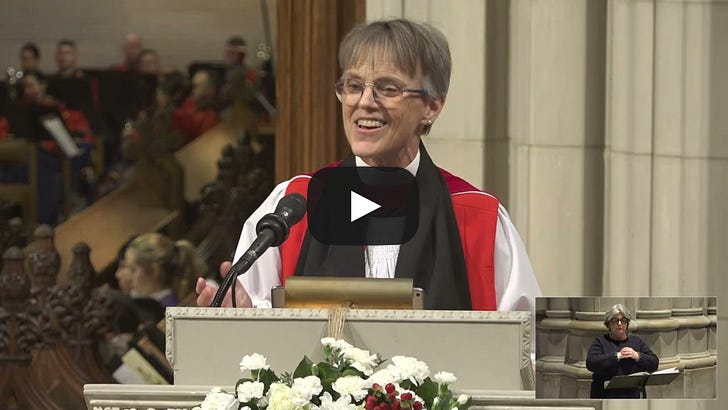
As a country, we have gathered this morning to pray for unity as a nation—not for agreement, political or otherwise, but for the kind of unity that fosters community across diversity and division, a unity that serves the common good.

Unity, in this sense, is the threshold requirement for people to live together in a free society, it is the solid rock, as Jesus said, in this case upon which to build a nation. It is not conformity. It is not victory. It is not polite weariness or passive passivity born of exhaustion. Unity is not partisan.

Rather, unity is a way of being with one another that encompasses and respects our differences, that teaches us to hold multiple perspectives and life experiences as valid and worthy of respect; that enables us, in our communities and in the halls of power to genuinely care for one another, even when we disagree. Those across our country who dedicate their lives, or who volunteer to help others in times of natural disaster, often at great risk to themselves, never ask those they are helping for whom they voted in the past election or what positions they hold on a particular issue. And we are at our best when we follow their example.

Unity at times, is sacrificial, in the way that love is sacrificial, a giving of ourselves for the sake of another. In his Sermon on the Mount, Jesus of Nazareth exhorts us to love not only our neighbors, but to love our enemies. And to pray for those who persecute us, to be merciful as our God is merciful, and to forgive others as God forgives us. Jesus went out of his way to welcome those whom his society deemed as outcasts.

Now, I grant you that unity in this broad, expansive sense is aspirational, and it’s a lot to pray for—it is a big ask of our God, worthy of the best of who we are and who we can be. But there isn’t much to be gained by our prayers if we act in ways that further deepen the divisions among us. Our Scriptures are quite clear about this: God is never impressed with prayers when actions are not informed by them. Nor does God spare us from the consequences of our deeds, which always, in the end, matter more than the words we pray.

Those of us gathered here in the Cathedral, we are not naïve about the realities of politics. When power, wealth and competing interests are at stake, when views of what America should be are in conflict; when there are strong opinions across a spectrum of possibilities and starkly different understandings of what the right course of action is, there will be winners and losers when votes are cast, decisions made, that set the course of public policy and the prioritization of resources. It goes without saying that in a democracy, not everyone’s particular hopes and dreams can be realized in a given legislative session or a presidential term, not even in a generation. Not everyone’s specific prayers, for those of us who are people of prayer, not everyone’s specific prayers will be answered as we would like. But for some, the loss of their hopes and dreams will be far more than political defeat, but instead a loss of equality and dignity, and their livelihoods.

Given this, is true unity among us even possible, and why should we care about it?

Well, I hope that we care. I hope that we care, because the culture of contempt that has become normalized in our country threatens to destroy us. We are all bombarded daily with messages from what sociologists now call, “the outrage industrial complex”—some of that driven by external forces whose interests are furthered by a polarized America. Contempt fuels our political campaigns and social media, and many profit from it. But it is a dangerous way to lead a country.

I am a person of faith, surrounded by people of faith. And with God’s help I believe that unity in this country is possible—not perfectly, for we are imperfect people and an imperfect union—but sufficient enough to keep us believing in and working to realize the ideals of the United States of America—ideals expressed in the Declaration of Independence, with its assertion of innate human equality and dignity.

And we are right to pray for God’s help as we seek unity, for we need God’s help, but only if we ourselves are willing to tend to the foundations upon which unity depends. Like Jesus’ analogy of building a house of faith on the rock of his teachings, as opposed to building a house on sand, the foundations we need for unity must be sturdy enough to withstand the many storms that threaten it.

What are they, the foundations of unity? Drawing from our sacred traditions and texts, let me suggest that there are at least three.

The first foundation for unity is honoring the inherent dignity of every human being, which is, as all faiths represented here affirm, the birthright of all people as children of our One God. In public discourse, honoring each other’s dignity means refusing to mock or discount, or demonize those with whom we differ, choosing instead to respectfully debate across our differences, and whenever possible, to seek common ground. If common ground is not possible, dignity demands that we remain true to our convictions without contempt for those who hold convictions of their own.

A second foundation for unity is honesty in both private conversation and public discourse. If we aren’t willing to be honest, there is no use in praying for unity, because our actions work against the prayers themselves. We might, for a time, experience a false sense of unity among some, but not the sturdier, broader unity that we need to address the challenges that we face.

Now to be fair, we don’t always know where the truth lies. There is a lot working against the truth now, staggeringly so. But when we do know, when we know what is true, it’s incumbent upon us to speak the truth, even when—especially when—it costs us.

And the third and last foundation for unity I will mention is humility, which we all need, because we are all fallible human beings. We make mistakes. We say and do things that we regret. We have our blind spots and biases. And perhaps we are the most dangerous to ourselves and others when we are persuaded, without a doubt, that we are absolutely right and someone else is absolutely wrong—because then we are just a few steps away from labeling ourselves as the good people, versus the bad people.

The truth is that we are all people, capable of both good and bad. Aleksandr Solzhenitsyn astutely observed that “The line separating good and evil passes not through states, nor between classes, nor between political parties, but right through every human heart and through all human hearts.” The more we realize this, the more room we have within ourselves for humility, and openness to one another across our differences, because in fact, we are more like one another than we realize, and we need each other.

Unity is relatively easy to pray for on occasions of great solemnity. It is a lot harder to realize when we are dealing with real differences in the public arena. But without unity, we are building our nation’s house on sand.

With a commitment to unity that incorporates diversity and transcends disagreement, and with the solid foundations of dignity, honesty, and humility that such unity requires, we can do our part, and in our time, to realize the ideals and the dream of America.

Let me make one final plea, Mr. President. Millions have put their trust in you. As you told the nation yesterday, you have felt the providential hand of a loving God. In the name of our God, I ask you to have mercy upon the people in our country who are scared now. There are gay, lesbian, and transgender children in Democratic, Republican. and independent families, some who fear for their lives.

And the people who pick our crops and clean our office buildings, who labor in our poultry farms and meat-packing plants, who wash the dishes after we eat in restaurants and work the night shifts in hospitals. They may not be citizens or have the proper documentation, but the vast majority of immigrants are not criminals. They pay taxes and are good neighbors. They are faithful members of our churches and mosques, synagogues, gurdwaras, and temples.

May I ask you to have mercy, Mr. President, on those in our communities whose children fear that their parents will be taken away—and that you help those who are fleeing war zones and persecution in their own lands to find compassion and welcome here. Our God teaches us that we are to be merciful to the stranger, for we were all once strangers in this land.

May God grant us the strength and courage to honor the dignity of every human being, to speak the truth to one another in love, and to walk humbly with one another and our God, for the good of all people, for the people in this nation and the world.

Tuesday, December 3, 2024

Trump again

 I voted for Kamala Harris. But to sit through election night and watch her vote tallies fall short in my current home state and my future home state made me ask why, what happened, whose fault was it, etc. All kinds of questions and many of them about the hearts and minds of those who supported Trump. Polls told us that the "state of democracy" and the economy were the major contributing concerns of voters. These categories did not mean the same things to all voters.

As I was listening to the commentators, whose biases remain progressive, egalitarian, and transparent, I heard them slipping from confidence, to hope, to concern, to sadness and I slipped just slightly ahead of them. So . . . that's what happened. 

Now it is December and I am more aware of the less than helpful way my usual sources informed me and my "fellow travelers." They missed something about the Trump campaign's machinery and methods. It seems they performed their own version of the Democratic party's reliance on precedent and custom. It was as if they -- Biden and Harris, too -- thought honor, trust and gentility were more important than "winning." That was true as long as you could count on a majority of Republicans to share that belief. History will show them long bereft of that historic -- perhaps mythological -- manner.

Certainly Harris made some space between her campaign and the White House. I think mostly by avoidance and busy-ness. "Not going back!" wasn't just about correcting Trump's MAGA obsession it was a soft exit from Biden's gravitational field, too. My thinking here is to make sense of things like her finding a position mostly by nuance that was not locked to Biden's support of Israel such that he couldn't say enough or do enough to protect the legitimate resident's of Gaza. Harris tried to move toward Gaza just enough but could only get so far without scaring her well-heeled Israeli supporting donors. 

All the while Trump and Vance verbally pissed on foe and even at times, friend. It feels like they knew something about their voters. They knew there were more in the right places than most polls could verify. And they knew there was a path -- mostly via that damned Electoral College. I'm thinking they knew because they had already put something in place. Meanwhile, much -- perhaps most -- of their "pissing" was an assurance that those voters were "in."

That assurance may become a deceit, at least as far as predictions about the economic effect of tariffs and deportation can be believed. Didn't Musk tell us there was going to be hardship? Hasn't Trump more than doubled down on his tariff promise? He's going beyond his original China, Mexico, and Canada. He's also upping the ante, threatening 100% tariffs on BRICS. Trustworthy economists are generally forecasting harder times than Musk's warning indicated. Minus Trump's ultra wealthy supporters those hardships will befall -- just like Trump's piss -- foe AND friend.

We are now solidly in the land of oligarchs. As much as MAGA invokes the past, don't confuse them with dinosaurs. They are ready to pay for all the tyranny Trump can provide as cover for their thumbing the scales in their favor. Tax cuts are just the obvious methods. To their benefit and theirs alone they will continue to fund a destruction of our beloved country and government one "cabinet" at a time.

Maybe to my detriment I believed ours would continue as a system "of, by, and for the people." I'm willing to consider that my belief is not a memory or a recent history. It is certainly an aspiration. But I cannot see a way forward to citizenship as constitutionally established with Trump's oligarchs hoarding the wealth they did not make and getting the government they purchasing for themselves alone.

Timothy Snyder is the best voice I hear for how we can again become citizens who will grow into an even more progressive, egalitarian, and transparent society.

On the way, I hope to demonstrate the values of honor, trust and gentility. I know I do not intend to respond in a vengeful or selfish way. I also know that I cannot count on "precedent and custom" to win the day. Those historic standards are now dependent on a more muscular and vigilant practice. We cannot afford naiveté or passivity. It means being a good citizen has radically changed.

So . . . what do I do? I start by managing my own life into being nimble and helpful. Part of being nimble is to hone the "voice" I have as an older educated white man. I am a retired Episcopal priest, so I am conversant with others who have power and profess a belief in grace. As well, I'm pretty sure I know someone who is likely to need my help. I want to be able to respond. Like Brian McLaren wrote a while back, we make the road by walking. There's more, much more to come. Pay attention.

From Blogger iPhone client

Thursday, April 13, 2023

What's Your Episcopal Church like?


 A member of our vestry attended the Congregational Vitality breakout group at Annual Council.  The discussion was in response to sharing these 14 attributes of typical Episcopal parishes and of the The Episcopal Church in general.  View the video as many times as you need to identify the attributes that are active in your appreciation of the church as your church from within your community.